



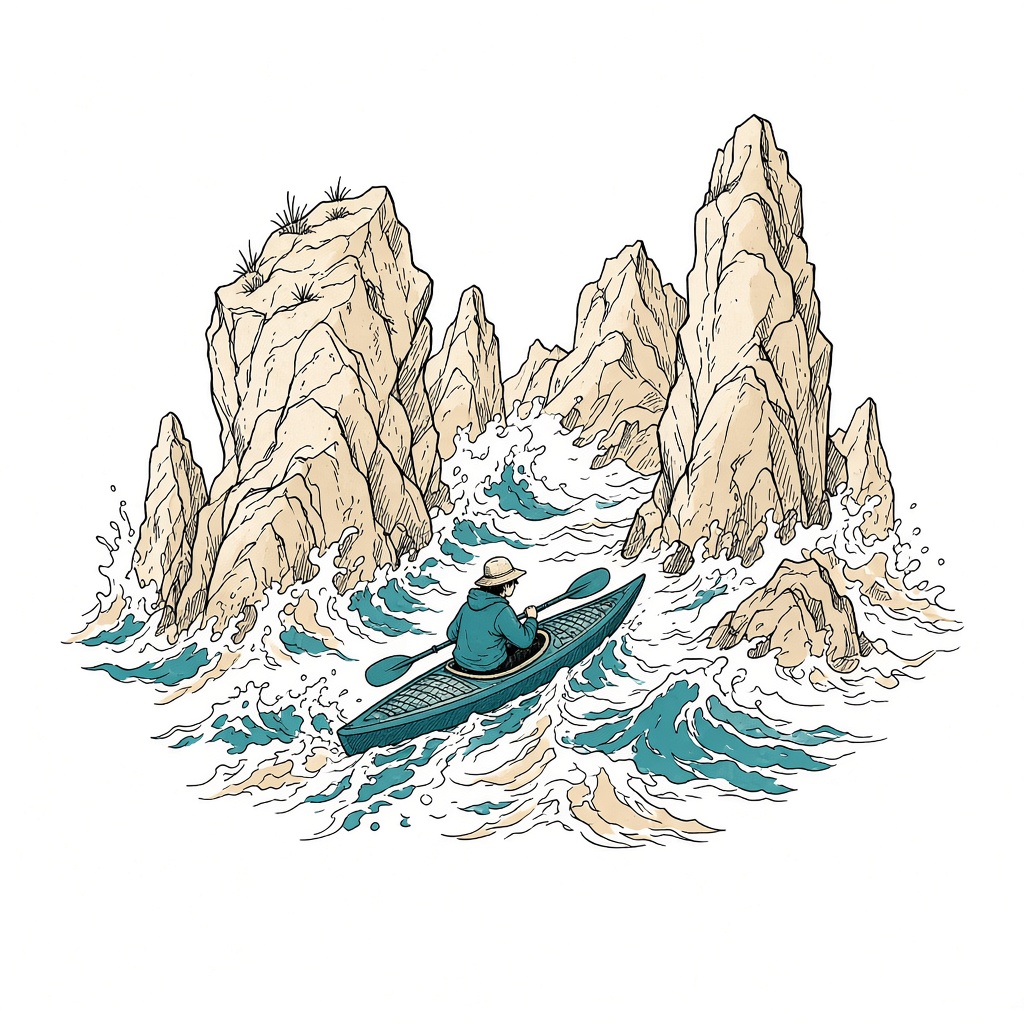
ACA Level 5: Advanced Open Water Coastal Kayaking. L5 is the top of the coastal ladder: reflex boat handling, a reliable roll, and care for the whole group in stronger wind, wave or current. The assessment needs two venue-specific categories, not one.
Venue and window
Exposure with an area of retreat; no-landing zones may be used. At least three of: 15–25 kn; 3–5 ft waves; 3–5 ft surf; current greater than 4 kn.
How far each skill must go at this level
Place the boat on purpose in L5 water; blend strokes and edge; brace a near miss; roll consistently across venues.
360° awareness; several tows (in-line, rafted, anchor, contact…); release under load, including inverted; reconnect a swimmer to their boat.
Recover with a spare.
Pick venues, change the plan, and position so others stay inside their limit.
Run L5 routes and shift aim points in poor visibility; tidal drift maths for a crossing of at least ~3 hours (meet the standard — you are not teaching a class).
Expedition, tide races (including play), surf (including control while surfing), rock gardens and sea caves.
What the course actually teaches
Modules: Rock Gardens & Sea Caves; Rough Water Manoeuvring & Towing; Advanced Surf Zone. Confirm the roll and the tow system before rock, surf or race.
ACA duration versions
Each needs its own condition window; typically a full day or a two-day block.
All core items plus two venue-specific categories. Often more than one day so the window is real.
This is a personal skills ceiling, not an instructor or trip-leader award by itself. Those pathways have their own current ACA documents.
The text below is the latest ACA official instructional outline (Skills Course) for this level, provided as reference only. Copyright American Canoe Association. The summary above is Kayacool’s explanation, not a replacement of the source.
Level 5: Advanced Open Water Coastal Kayaking Rock Gardening & Sea Caves
Skills Course Overview
The Coastal Kayak Rock Garden and Sea Cave Skills & Safety course is designed to teach paddlers how to paddle safely within rock gardens, run features, explore sea caves and perform self and assisted rescues in these dynamic environments.
Course Objectives
Participants will be introduced to:
- Dynamics of the rock garden; interaction of swell, wind and tide
- Identification of hazards and safe areas
- Selection of features for play
- Setting up for and running a pour-over
- Safe exploration of sea caves
- Modification of existing rescue techniques to the rock garden and sea cave environments
Skills Course Prerequisites
- Acknowledgment of personal compliance with the ACA Essential Eligibility Criteria (EEC)
- ACA Coastal Kayak skills at the appropriate level including bracing skills and a
reliable roll or self-rescue
Minimum Personal Equipment for the Course:
Whitewater or sea kayaks. Sit inside or sit-on-top kayaks can be used. The more maneuverable, plastic sea kayaks may be preferable. All kayaks will have adequate flotation. Helmets, life jackets, and paddling clothing appropriate to water temperature are required.
Course Duration
The course duration should be adjusted to best fit the needs and goals of the participants. Suggested time: Half a day to one day (4-8 hours).
Course Location / Accessible Venues
Conditions shall not exceed the venue conditions for the level of the course; that is, an L3 course shall not exceed the venue conditions for the Level 3: Coastal Kayak Instructor Criteria; an L4 course shall not exceed the venue conditions for the Level 4: Open Water Instructor Criteria; and, an L5 course shall not exceed the venue conditions for the Level 5: Advanced Open Water Coastal Kayaking Instructor Criteria. An area of rock garden should have sufficient deep water and safe areas; sea caves should be back filled with sand or rock (debris free), and thoroughly inspected for hazardous tunnels and underwater obstructions.
Course Size
5 Participants : 1 Instructor; with an additional qualified assistant, the ratio can be 10 : 2.
For additional details, see SEIC Policy Manual Chapter 7.
Instructor
This course may be offered by Level 5: Advanced Open Water Coastal Kayaking ACA Instructors, Instructor Trainers, or Instructor Trainer Educators.
Course Outline
The following is a general summary of content for this course. The content and sequence of instruction should be adjusted to best fit the participant’s needs, class location and time allowance.
Introduction, Expectations, and Logistics
Introduction, Expectations, and Logistics:
- Welcome, introductions, paperwork
- Student and Instructor course expectations and limitations
- Course itinerary and site logistics
- Review waiver, assumption of risk, challenge by choice, medical disclosure
- About the ACA
- Life jacket policy (always wear on water)
- Appropriate personal behavior
- No alcohol / substance abuse
- Proper etiquette on and off the water
- Respect private property
- Practice Leave No Trace ethics
Paddling Environment:
- Forecast - trend
- Weather
- Wind
- Waves (swell, period, sets)
- Water - tide/current/temperature
Personal Preparation:
- Personal ability
- Swimming ability
- Water comfort and confidence
- Wet exits in two ways: (1) utilizing the sprayskirt grab loop and (2) releasing the skirt off the hip
- Fitness, conditioning, and warm up
- Safe paddle and boat handling
- Personal equipment (reviewed by Instructor)
On-shore Orientation
- Equipment fit & adjustment
- Safety concepts (brief discussion)
- Review of CLAP mnemonic including paddle and hand signals & “Outside” call (see notes).
- Avoid collisions; stay out of each other’s way.
- If swimming, stay seaward of kayak.
- Avoid shoulder dislocation by keeping paddle low when bracing
- No hands on rocks!
- Review use of side slip, low brace turn and bow rudder for boat control
Transition through rock garden, identifying safe zones, transition zones and hazards
- Use large rocks for protection, practice holding position
- Timing movement through transition zones during lulls
- Practice paddling through gaps, using angle and safety margin to counteract push/pull from surge/swell
- Maintain line of sight and position for safety before and after each feature, bows facing oncoming swell
- Practice “Outside” drill (see notes)
Instructor demonstration of technique of running a pour-over
- Timing using an off-shore reef or other feature as an indicator of approaching swell
- Position just outside of aerated water
- Consider angle of approach to facilitate safe exit
- Power forward strokes to accelerate and match speed of swell
- Set up for “boof” of drop(whitewater kayak) or low/high brace position (sea kayak)
- Safety cover provided by observer positioned for bow rescue
- Allow students to practice features repeatedly, working on timing, stroke sequences, angle of entry and exit
Cave Exploration
- Instructors identify suitable cave for exploration. Carefully examine for dangerous tunnels with surge and no exit with potential to trap a boat or body
- Ensure sufficient observation through several wave sets before entering
- Enter by paddling backwards unless cave is exceptionally large and there is no danger of a closeout set
- Maintain line of sight and group coherence during exercise
On-Shore Discussion
During (or just after) lunch review and discuss (use props):
- Any issues from the morning session - spontaneous incidents
- Risk assessment model
- Rescue priorities
- Rescue methods
- Review of tow systems and methods
Pour-Over Practice
- Continue practice identifying features, reading and timing waves to run features
- Encourage teamwork and CLAP principles
Rescue Practice
- Swimming with kayak to safe area followed by self-rescue
- Swimming using paddle towing kayak
- Bow/stern toggle tow of swimmer and kayak
- Bow/stern carry of swimmer (no kayak)
- Javelin (push) tow of kayak
- Contact tows
- Deployment of short tow-line
- Hook and tow, capsize and release
- Throw ropes – pros and cons
- Emergency landing
Rescue Scenarios
- Dislocated shoulder
- Unconscious swimmer
- Damaged kayak - Cleopatra’s needle
- Cave rescue
Conclusion and Wrap Up
- Group debrief / individual feedback
- Course limitations
- Importance of First Aid and CPR
- Importance of additional instruction, practice, and gaining experience
- Importance of appropriate level of safety and rescue training
- Life sport / paddling options
- Local paddling groups / clubs
- Handouts / reference materials
- Participation cards
- ACA membership benefits and join process
NOTES:
The "Outside" call is internationally recognized as a verbal warning to other surfers or
paddlers that an unusually large wave is coming. The call should be immediately repeated
by the group to ensure everyone has heard it. At the very least paddlers should look in the
direction of the oncoming wave and make their own judgment about what to do based on
their position and assessment of the hazards presented. The most typical response would
be to generate momentum towards the oncoming wave.
The 'Outside Drill' is introduced very early into a sea kayak rock garden or surfing class
(before we get into any areas of breaking waves) to get everyone on the same page with
regard to the "Outside" call and to have students begin to think about their positioning
and the strokes they would use to generate momentum towards an oncoming wave.
Guided discovery is typically used by having students paddle parallel to shore, all
pointing in the same direction and the leader’s position is slightly offshore from them.
The leader will then call "Outside" and see how many students repeat the call, and
observe the strokes they choose to use. A brief discussion of the pros and cons of strokes
that generate momentum such as the forward sweep (if traveling forwards) compared to a
braking stroke such as the reverse sweep.
After practicing the drill a few times, and encourage students to try different strokes and
compare the tightness of the radius of their turn with the amount of momentum
generated. Then discuss proximity of other paddlers, protection afforded by large rocks
and what to do if you are unsuccessful in punching through the oncoming wave.
This is normally finished off by having students pointing their bows directly towards
shore. When the leader calls "Outside", some students will complete a pivot turn before
paddling towards the wave, others will paddle in reverse. Briefly discuss the pros and
cons of both choices. The 'Outside Drill' is a great way to assess your students’ skills and
ability to make decisions before entering more dynamic water conditions.
© American Canoe Association
Date of last revision: 5/1/2024
This curriculum is managed by the ACA Coastal Kayaking Committee.
Level 5: Advanced Open Water Coastal Kayaking Rough Water Maneuvering Towing and Rescue
Skills Course Overview
The Coastal Kayak Rough Water Maneuvering, Towing and Rescue course is designed to teach paddlers how to read and surf waves with good boat control
Course Objectives
Participants will be introduced to:
- Plan a rough water outing
- Practice decision-making process to manage risk
- Determine proper equipment
- Practice group formations and communicate in rough water
- Perform advanced strokes in rough water
- Perform towing exercises in rough water
- Perform self and assisted rescues in rough water with loaded boats
- Launch and land through moderate surf, if available
- Transit through areas of moderate current or tidal rip where necessary, if available
Skills Course Prerequisites
- Acknowledgment of personal compliance with the ACA Essential Eligibility Criteria (EEC)
- Completion of an open water course and proficiency and experience in executing all strokes, maneuvers and techniques in open water.
- A reliable roll and the ability to aggressively self-rescue required
Minimum Personal Equipment for the Course:
Properly sized and outfitted sea kayaks with front and rear flotation and related paddling and safety equipment (I.e. paddle & spare, PFD, spray skirt, tow rig, paddle float, bilge pump, wet/dry suit & hypothermia kit if necessary, helmet, first aid kit, repair kit, emergency signaling devices appropriate for the time and area of travel, extra clothes, food and water).
Course Duration
The course duration should be adjusted to best fit the needs and goals of the participants. Suggested time: Half a day to one day (4-8 hours).
Course Location / Accessible Venues
The selected venue should provide access to open water and at least one set of conditions within the following ranges, with constant access to safe landing:
- Surf of at least 3 foot (1 meter)
- Current at least 4 knots
- Wind at least 15 knots
- Waves (chop) of at least 3 foot (1 meter)
Environmental conditions must be assessed for their contributions to student learning and risk, including effects of multiple criteria superimposed simultaneously; effects of wind, swell, and/or current direction; and character of surf break (e.g. spilling vs dumping, beach vs rocky shore) if used. Selection of and continued operation in venues must be guided by a sound understanding and continuous monitoring of environmental conditions, with application of sound judgment to ensure safety and provision of an optimal learning environment.
*Instructors should reduce student to instructor ratio when conditions warrant.
Course Size
5 Participants : 1 Instructor; with an additional qualified assistant, the ratio can be 10 : 2.
For additional details, see SEIC Policy Manual Chapter 7.
Instructor
This course may be offered by Level 5: Advanced Open Water Coastal Kayaking ACA Instructors, Instructor Trainers, or Instructor Trainer Educators.
Course Outline
The following is a general summary of content for this course. The content and sequence of instruction should be adjusted to best fit the participant’s needs, class location and time allowance.
Introduction, Expectations, and Logistics
Introduction, Expectations, and Logistics:
- Welcome, introductions, paperwork
- Student and Instructor course expectations and limitations
- Course itinerary and site logistics
- Review waiver, assumption of risk, challenge by choice, medical disclosure
- About the ACA
- Life jacket policy (always wear on water)
- Appropriate personal behavior
- No alcohol / substance abuse
- Proper etiquette on and off the water
- Respect private property
- Practice Leave No Trace ethics
Paddling Environment:
- Wind
- Waves
- Weather
- Water
Personal Preparation:
- Personal ability
- Swimming ability
- Water comfort and confidence
- Wet exits in two ways: (1) utilizing the sprayskirt grab loop and (2) releasing the skirt off the hip
- Fitness, conditioning, and warm up
- Safe paddle and boat handling
- Personal equipment (reviewed by Instructor)
Dry-Land Presentations
- Trip planning and risk assessment (wind, weather, waves, tides, currents, group gear).
- Equipment check/orientation, (boat, clothing, gear, first aid, repair, navigation, communication, hypothermia kits)
- Group formations and communication
Launching Through Mild Surf
- Boat positioning and alignment.
- Sequence and spacing.
- Powering through the break.
- If all goes wrong, where to meet on the other side
Note: Assisted rescues should not be attempted in shore break
Strokes in Rough Water
- Sweeps from a static position (looking through the turn, edging, and driving with the pegs)
- Using the tops of waves to turn
- Turning into the wind (sweeps with edge control to increase weather cocking, bow draws and static brace turns)
- Turning down wind (use of edge control to free the bow, stern rudders, reverse strokes and skeg use to assist in lee cocking
- Surfing wind waves and swell (when to accelerate, use of correction strokes and stern rudders)
Rough Water Towing
- The single tow, in-line tow, contact tow and rafted tow
- Towing a rescue in progress, and releasing under tow
Landing in Mild Surf
- Sequence and spacing
- Wave selection
- To ride or not to ride
- Landing on the top or riding the face
- Wave dynamics and boat control
Rough Water Rescues
- The swimmer bow rescue
- Back deck rescue
- The bow and paddle shaft rescues.
- Rolling in waves and current.
- Self-rescues (re-entries):
- Re-Enter and roll
- Re-Enter and roll w/ paddle float
- Paddle float self rescue (back deck)
- Cowboy (scramble) self rescue
- Assisted Rescues:
- T-Rescue with back deck re-entry
- T-Rescue with crab re -entry
- T-Rescue with swimmer at bow
- Loaded boat options for assisted rescues:
- Assisted T
- Hull down method of crossing the “T”
- Re-enter and pump
- Curl (swamped hatch recovery)
Note: These are suggested exercises. Instructors must weigh time, safety and logistical concerns in deciding which if not all exercises are to be covered
Additional Land / Water Exercises
- Review weak spots or move on to take advantage of local conditions
- May include current and tidal rip training if conditions, skill and energy permit
- Predicting tides/current
- Crossing eddy lines
- Surfing standing waves
- Calculating ferry angles
Conclusion and Wrap Up
- Group debrief / individual feedback
- Course limitations
- Importance of First Aid and CPR
- Importance of additional instruction, practice, and gaining experience
- Importance of appropriate level of safety and rescue training
- Life sport / paddling options
- Local paddling groups / clubs
- Handouts / reference materials
- Participation cards
- ACA membership benefits and join process
© American Canoe Association
Date of last revision: 5/1/2024
This curriculum is managed by the ACA Coastal Kayaking Committee.
Level 5: Advanced Open Water Coastal Kayaking Surf Zone Skills Course
Skills Course Overview
The Coastal Kayak Advanced Surf Zone course is designed to teach paddlers how to read and surf waves with good boat control.
Course Objectives
Participants will be introduced to:
- Surf zone dynamics, etiquette, and hazards
- Wave selection
- Where to catch waves
- Boat control and positioning on the wave
- Basic maneuvers, including cutbacks and bottom turns
Skills Course Prerequisites
- Acknowledgment of personal compliance with the ACA Essential Eligibility Criteria (EEC)
- ACA Coastal Kayak Surf Zone course, bracing skills, and a reliable roll
Minimum Personal Equipment for the Course
Whitewater or surf kayaks. Sea kayaks or sit-on-tops can be used, but the more maneuverable whitewater kayaks may be preferable. All boats should have adequate flotation. Helmets, PFDs, and paddling clothing appropriate to water temperature.
Course Duration
The course duration should be adjusted to best fit the needs and goals of the participants. Suggested time: Half a day to one day (4-8 hours).
Course Location / Accessible Venues
The chosen venue should present surf conditions carefully selected to maximize learning. Lead instructors will demonstrate an ability to read and interpret environmental conditions and their contributions to student learning and risk, including effects of multiple criteria superimposed simultaneously: effects of wind, swell, and/or current direction, and character of surf break (i.e., spilling vs dumping, beach vs rocky shore). Selection of and continued operation in venues must be guided by a sound understanding and continuous monitoring of environmental conditions, with candidates demonstrating application of sound judgment to ensure safety and provision of an optimal learning environment.
Course Size
5 Participants : 1 Instructor; with an additional qualified assistant, the ratio can be 10 : 2.
For additional details, see SEIC Policy Manual Chapter 7.
Instructor
This course may be offered by Level 5: Advanced Open Water Coastal Kayaking ACA Instructors, Instructor Trainers, or Instructor Trainer Educators.
Course Outline
The following is a general summary of content for this course. The content and sequence of instruction should be adjusted to best fit the participant’s needs, class location and time allowance.
Introduction, Expectations, and Logistics
Introduction, Expectations, and Logistics:
- Welcome, introductions, paperwork
- Student and Instructor course expectations and limitations
- Course itinerary and site logistics
- Review waiver, assumption of risk, challenge by choice, medical disclosure
- About the ACA
- Life jacket policy (always wear on water)
- Appropriate personal behavior
- No alcohol / substance abuse
- Proper etiquette on and off the water
- Respect private property
- Practice Leave No Trace ethics
Paddling Environment:
- Wind
- Waves
- Weather
- Water
Personal Preparation:
- Personal ability
- Swimming ability
- Water comfort and confidence
- Wet exits in two ways: (1) utilizing the sprayskirt grab loop and (2) releasing the skirt off the hip
- Fitness, conditioning, and warm up
- Safe paddle and boat handling
- Safety and rescue considerations
- Personal equipment (reviewed by Instructor)
On-shore Orientation
- Enrollment/Registration/Liability
- Equipment fit & adjustment
- Previous experience, expectations
- Course schedule & goals
- Safety concepts (brief discussion)
- Avoid collisions; stay out each other’s way. Closest to break has the wave; others should
yield. Please emphasize and repeat this throughout the day! - If swimming, stay seaward of kayak
- Avoid shoulder dislocation by keeping paddle low when bracing.
- Avoid collisions; stay out each other’s way. Closest to break has the wave; others should
- Review basics of launching, landing, side surfing (boat lean)
- Review use of stern rudder stroke for directional control
Instructor demonstration of surfing technique
- Instructor demonstrates catching a wave and riding in the “pocket.” Also demonstrate broaching, using boat lean, as a review. With two instructors, one can do the demo, while the other remains ashore to explain the maneuvers being demonstrated.
Surfing Practice
- Surf Zone: Instructors wade in the soup zone: Work with students in the soup zone; check out their ability to side surf and brace, then have them surfing small waves using stern rudder strokes for control in the soup.
- Surfing: As students improve, send them farther outside to catch the larger waves. Instructors may need to get into boats at this point (or swim out). Help the students select and catch good waves; give them feedback after each ride.
On-Shore Discussion
During (or just after) lunch review and discuss (use props):
- Any issues from the morning session
- Where to catch a wave
- How to stay in the pocket
- How to do a bottom turn
- How cut back toward the break
- Anything else that is needed
Surfing Practice
- Continue practice reading and catching waves
- Work on bottom turns, first away from the break, then toward the break (if reasonable)
- Work on turns and cutbacks while riding the wave
- Students who are having problems should practice in soup
- Watch for tired students & have them rest occasionally
Conclusion and Wrap Up
- Group debrief / individual feedback
- Course limitations
- Importance of First Aid and CPR
- Importance of additional instruction, practice, and gaining experience
- Importance of appropriate level of safety and rescue training
- Life sport / paddling options
- Local paddling groups / clubs
- Handouts / reference materials
- Participation cards
- ACA membership benefits and join process
© American Canoe Association
Date of last revision: 5/1/2024
This curriculum is managed by the ACA Coastal Kayaking Committee.