



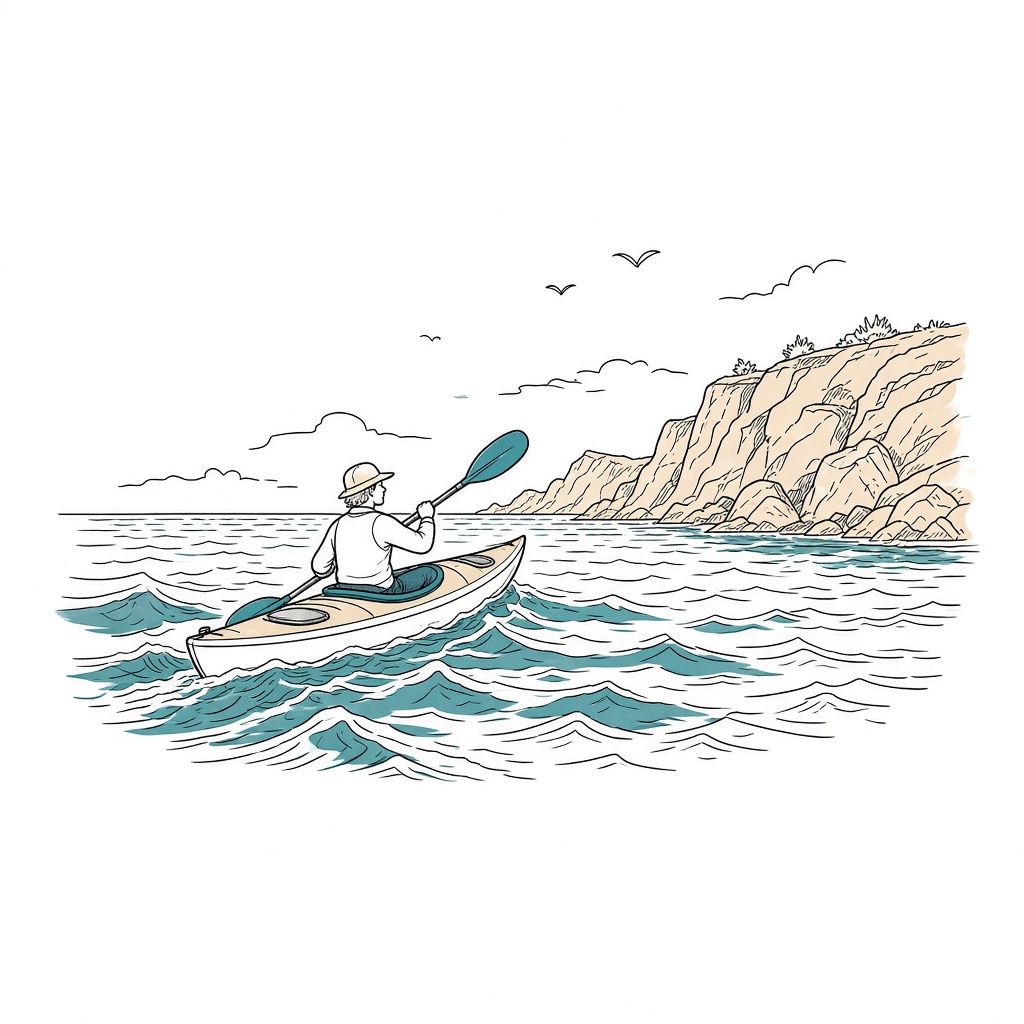
ACA Level 3: Coastal Kayaking. L3 是能在「有点暴露、但仍能找到登陆点」的海岸带安全活动的一级。技术要在 L3 海况里有效,而不只是平水里好看。评估时核心技能必须达标;场地专项选一类即可。
水域与窗口
距岸约 1.5 海里内、可登陆。评估须在下列四项中至少三项出现(不必同时):风 10–15 节;浪 1–2 英尺;岸边浪 1–2 英尺;潮流 1–2 节。
该级要做到什么程度
在 L3 海况里用压舷、桨叶入水与桨叶角把船放到该在的位置;两边都要能用,允许略有差别。
旋转干净、转向有边、横移能走直线;要求的是结果(船到点),不是某一指定花式名称。
失衡时能用高撑防止翻船。
带喷裙、在 L3 海况里有控制地湿翻离艇。
会救能配合的落水者(并靠 / T 救援 / 甲板运送等选一种做到位),也会救行动不便者(铲救 / 吊带 / 无反应者等选一种)。
滚翻再入、桨浮或 scramble 等至少一种,在该级海况里能完成。
会选合适拖带,会管理拖绳;也能不用拖绳把艇移走(接触拖 / 顶推等)。
会参与出发/收工简报,安全登陆,会用 VHF 的基本操作与求救思路;会写完整浮游计划。
课上教什么
先把核心桨、救援、拖带放到有风浪或潮流的窗口里练,再选一项场地:潮流、风浪岸边浪、或岩岸。Developing skills(加分项)失败不单独判挂,但核心项必须达标。
ACA 常见时长版本
官方技能课 Level 3: Coastal Kayaking Basic Strokes and Rescues,一天起步,把桨、湿翻、T 救援与桨浮打底。
Strokes and Maneuvers Refinement:在已有救援的前提下加长压舷、转向与浪中走位,时长由教练按大纲拉,常见再加一日。
可一日完成,评估员也可拉长。须在符合窗口的海况里看核心项,并完成一类场地专项。
另有 Sit-on-Top Coastal Kayaking。想走教练或领队路径,通过 L3 技能评估是常见前提,以当期 ACA 文件为准。
以下为该级别对应的最新 ACA 官方教学指导原文(Skills Course),仅作对照参考。版权属 American Canoe Association。上文是 Kayacool 的说明,不是对原文的替换。
Level 3: Coastal Kayaking Basic Strokes & Rescues Skills Course
Skills Course Overview
The Coastal Kayak Basic Strokes and Rescues course is designed to introduce basic coastal kayaking skills and safety to beginners.
Course Objectives
Participants will be introduced to:
- Proper fit and adjustment of their kayak for effective control and comfort
- Attaching and releasing the spray skirt
- Safely entering and exiting kayak, including wet exit
- Effective use and control of the paddle
- Performing basic strokes efficiently
- Performing T-rescue and Paddle float self rescue
- The importance and influence of weather and tides on the coastal kayaker
- Dealing with marine hazards and other safety issues
- Understanding personal limitations and skill level
Minimum Personal Equipment for the Course:
- Properly sized and outfitted kayak with front and rear flotation.
- Standard gear and safety equipment (paddles, PFDs (lifejackets), spray skirt, paddle floats, bilge pumps, and appropriate clothing for weather and immersion)
Course Location / Accessible Venues
Lakes or coastal waters with potential areas of exposure to mild wind and wave conditions, with constant access to safe landing and within 1.5 nm from shore:
- 10 - 15 knot winds
- 1 - 2 foot waves (chop) (0.3 – 0.6 meters)
- 1 - 2 foot surf (0.3 – 0.6 meters)
- 1 - 2 knots of current
Instructor
This course may be offered by Level 3: Coastal Kayaking (or higher) ACA Instructors, Instructor Trainers, or Instructor Trainer Educators.
Succeeding Courses
Level 3: Coastal Kayak Strokes and Maneuvers Refinement Skills Course
Level 3: Coastal Kayaking Skills Assessment
Course Outline
The following is a general summary of content for this course. The content and sequence of instruction should be adjusted to best fit the participant’s needs, class location and time allowance.
Introduction, Expectations, and Logistics
Paddling Environment:
- Wind
- Waves
- Weather
- Water
Personal Preparation:
- Personal ability
- Swimming ability
- Water comfort and confidence
- Fitness, conditioning, and warm up
- Safe paddle and boat handling
- Safety and rescue considerations
- Personal equipment (reviewed by Instructor)
On Shore Presentations:
- Equipment orientation
- Personal clothing and gear
- PFDs, wetsuits, spray skirts
- Safety equipment
- Basic boat design and kayak terminology
- Boat fit and adjustment
- Boat/body weld
- Foot brace adjustment
- Spray skirt attachment/release
- Dry land “wet exit” drill
- Paddle orientation and use
- Correct hand placement
- Control hand/relaxed grip
- Torso rotation and paddler’s box
Launching & Landing / Wet-exit practice & Kayak Orientation:
- Carrying kayak to and from water
- Entry/exit of kayak from shore or dock
- Boat stability, “hip wiggle,” edging
- Practice wet-exits with one-on-one supervision by instructor (if in cold water environment, wait until rescue session)
- Wet exits must be modeled and taught two ways: (1) utilizing the spray skirt grab loop and (2) releasing the skirt off the hip.
- Allow students a few minutes to paddle around and get oriented with their kayak
Basic Strokes & Skills:
- Rafting up
- Sweep stroke (forward/reverse/pivot in place)
- Forward Stroke
- Reverse stroke and stopping
- Draw stroke
- High and low braces (hip snap/boat edging/lower body control)
On Land Discussion Items:
- Weather conditions
- Chart use
- Tides and currents (if applicable)
- Signaling and safety devices
Deep Water Rescues:
Note: Use stirrup if necessary
- Demonstrate and practice T-rescue
- Demonstrate and practice paddle float, and other self-rescues
- Demonstrate and practice towing, contact tow, as well as in-line tow
- Bonus: Reentry and roll with Paddle float
Group Safety Discussion:
- Group signals
- Staying together (i.e. lead/sweep)
- What to do in an emergency
- Dealing with boat traffic
Short Skills Development Tour:
- Continue to develop efficient stroke technique
- Practice course corrections
- Have fun
Conclusion and Wrap Up:
- Group debrief / individual feedback
- Course limitations
- Importance of first aid and CPR
- Importance of additional instruction, practice, experience
- Importance of appropriate level of safety and rescue training
- Demonstrate advanced maneuvers
- Life sport / paddling options
- Local paddling groups / clubs
- Handouts / reference materials
- ACA membership forms
- Course evaluation
- Participation cards
© American Canoe Association
Date of last revision: 5/1/2024
This curriculum is managed by the ACA Coastal Kayaking Committee.
Level 3: Coastal Kayaking Stroke & Maneuvers Refinement Skills Course
Course Overview
The Coastal Kayak Strokes and Maneuvers Refinement course is designed to assist coastal kayakers at all levels in refining basic strokes and maneuvers. It may be beneficial to re-take this course at different levels of skill progression.
Course Objectives:
Using on-water practice, classroom discussion and/or video analysis, participants will practice strokes/maneuvers to increase efficiency, fluidity and control.
Minimum Personal Equipment for the Course:
Properly sized and outfitted sea kayaks with front and rear flotation and related paddling and
safety equipment (i.e. paddles, PFDs, spray skirts, paddle floats, bilge pumps & wet suits if
necessary).
Course Location / Accessible Venues
Lakes or coastal waters with potential areas of exposure to mild wind and wave conditions, with constant access to safe landing and within 1.5 nm from shore:
- 10 - 15 knot winds
- 1 - 2 foot waves (chop) (0.3 – 0.6 meters)
- 1 - 2 foot surf (0.3 – 0.6 meters)
- 1 - 2 knots of current
Instructor
This course may be offered by Level 3: Coastal Kayaking (or higher) ACA Instructors, Instructor Trainers, or Instructor Trainer Educators.
Succeeding Courses
- Level 4: Open Water Coastal Kayaking, Surf Kayak, Tidal Skills, or Rough Water
Course Outline
The following is a general summary of content for this course. The content and sequence of instruction should be adjusted to best fit the participant’s needs, class location and time allowance.
Introduction, Expectations, and Logistics
Paddling Environment:
- Wind
- Waves
- Weather
- Water
Personal Preparation:
- Personal ability
- Swimming ability
- Water comfort and confidence
- Wet exits in two ways: (1) utilizing the sprayskirt grab loop and (2) releasing the skirt off the hip
- Fitness, conditioning, and warm up
- Safe paddle and boat handling
- Safety and rescue considerations
- Personal equipment (reviewed by Instructor)
Dry-Land Presentation:
- The dynamics of boat control
- The pressurized bow and free stern
- Shaft and blade angles, catch and release points, the box, torso rotation and driving the foot pegs
- Edging to unlock the trailing keel
- Working with wind
On-Water Presentations:
Strokes:
Forward Stroke
- Comfortable extension forward and maintain “paddler’s box”
- Hands at shoulder height and “in plane”
- Drive foot peg on the same side as the stroke
- Torso rotation (10 o’clock to 2 o’clock)
- Short stroke (in at feet out at hips)
- Relatively high shaft angle (depending on boat, anatomy, paddle length, etc.)
Sweep Stroke
- Torso rotation (windup)
- Blade in at feet just below water
- In flat water, follow blade with eyes
- In rough water, look through turn
- Maintain box and drive with on-water peg
- Catch, release = bow to stern waterline
- More edge = less waterline
- Low shaft angle for maximum extension
Reverse Strokes
(to propel, maneuver, stop)
Method A. Same initial set-up for propulsion, maneuvering, and emergency stops
- Maintain paddler’s box, rotate torso around spine, (don’t lean back), place back face flat on water, 45 degrees off keel line (will require that you edge the boat)
- Unwind torso while rotating wrist up & forward to keep back face loaded, blade just below surface
- To correct heading, hold edge longer and finish stroke further toward the bow
- Practice technique w/ reverse figure 8’s.
Method B. Different initial set-up for propulsion than for sweeps
- To propel or stop, position paddle parallel to the boat, back face down.
- Begin catch near 6 o’clock position and drive back face forward along the boat’s longitudinal axis
- To sweep, position paddle parallel to boat, back face out, blade near 6 o’clock position
- Drive back face out in an arc toward the bow, edging toward the on-water blade
Beam Draw Stroke (In-water Recovery)
- Face your work (rotate torso)
- Anchor off-water arm across chest
- Sight over off-water wrist
- Control with on-water hand
- Extend shaft and pull power face to boat
- Blade deep in water
- Rotate wrist and slice away for re-set
Sculling Draw
- Rotate torso to face your work
- Anchor both elbows and power with torso
- Vertical shaft
- Angle leading edge of blade slightly away
- Rotate wrist to change leading edge
- Short stokes (1-2 foot arc, 6-18 inches out) (0.3-0.6 meters, 15-45 cm)
Sculling For Support Refinement
- From high brace position, power face down
- Flat shaft angle
- Blade at surface, slight climbing blade angle
- Control with on-water hand
- Torso over water
- Don’t push down, create lift by pushing blade fore and aft with slightly high leading edge
Low Brace
- Flat shaft angle
- Elbow over shaft
- Maintain reference grip
- Use back face to create “depth charge”
- Hip snap to recovery
High Brace
- Flat shaft angle
- Elbow under shaft
- Slap power face on water
- Hip snap to recovery
Maneuvers
Low and High Brace Turn
- Establish hull speed
- Set up nose momentum with outside edge
- Transition quickly to inside edge
- Extend paddle blade and delay contact with the water
- Use back/power face with slightly climbing blade angle, and hold brace (do not jam forward until recovery)
- Recover with hip snap
- Transition to forward stroke
Bow Rudder
- Establish hull speed
- Initiate turn (outside edge and sweep)
- Submerge blade just forward of pivot point (usually just forward of 3-9 line)
- Rotate wrist slightly to open leading edge and load power face
- Control with on-water hand and allow off-water hand to drop to a comfortable fulcrum position
- Don’t over-expose power face
- Adjust as hull speed decreases
Stationary Draw (Hanging Draw, Side Slip)
- Establish hull speed
- Rotate to face your work
- Maintain box and extend paddle away
- Slice blade from aft quarter forward into place at about the 3 or 9 position as you edge the boat away from the paddle
- Rotate on-water wrist to keep leading edge angled slightly outward, away from boat.
- Search for the sweet spot
- Too far forward draws the bow
- Too far aft draws the stern
- “Option B,” transition from forward stroke to same blade placement and edge toward blade
Stern Rudder Refinement
- Establish hull speed
- Blade in water at stern quarter, with back face away from boat
- Slight edge to outside of turn
- Load back face to turn toward blade
- Load power face to turn away
Videotaping of Strokes
Transfer to Classroom
Video Playback & Analysis
(90 Minutes) (If timing and logistics allow, students may be given time to practice strokes again on water.)
Feedback
Students will be given feedback on their ability to:
- Identify component parts of each stroke
- Perform each stroke by connecting component parts with smooth transition, fluidity and control
Conclusion and Wrap Up
- Group debrief / individual feedback
- Course limitations
- Importance of first aid and CPR
- Importance of additional instruction, practice, experience
- Importance of appropriate level of safety and rescue training
- Demonstrate advanced maneuvers
- Life sport / paddling options
- Local paddling groups / clubs
- Handouts / reference materials
- ACA membership forms
- Course evaluation
- Participation cards
© American Canoe Association
Date of last revision: 5/1/2024
This curriculum is managed by the ACA Coastal Kayaking Committee.