



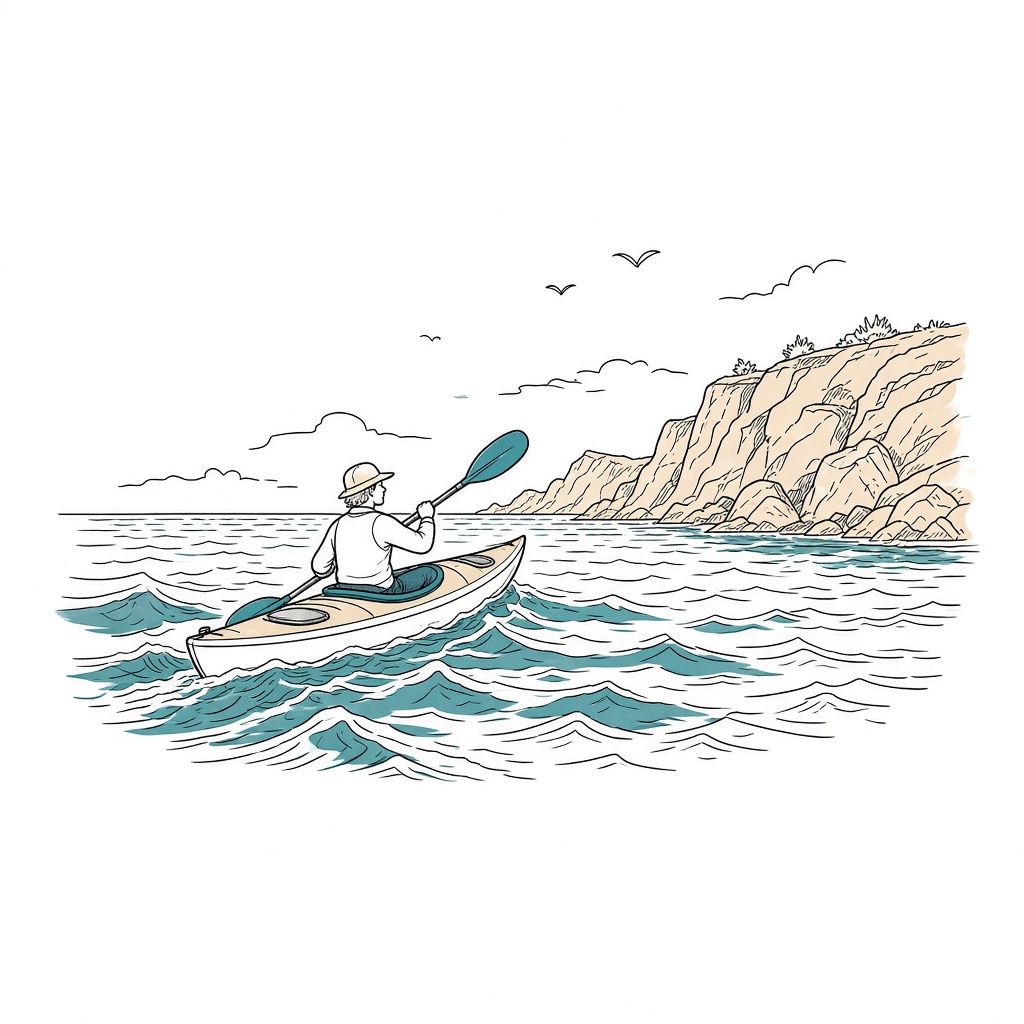
ACA Level 3: Coastal Kayaking. L3 ialah berkayak pesisir yang cekap dengan mendarat biasa. Kemahiran mesti jalan dalam keadaan L3. Kemahiran teras wajib; satu set venue khusus mencukupi.
Venue dan tetingkap
Dalam kira-kira 1.5 batu nautika dari pantai. Sekurang-kurangnya tiga daripada: angin 10–15 knot; ombak 1–2 kaki; surf 1–2 kaki; arus 1–2 knot.
Setakat mana setiap kemahiran di tahap ini
Guna edge dan sudut bilah untuk meletak bot dalam air L3.
Bot sampai ke titik. Nama trik bukan ujian.
Pulih dari tak seimbang.
Terkawal, dengan skirt, dalam keadaan L3.
Satu kaedah perenang mampu, satu kaedah perenang terjejas.
Re-enter and roll, paddle float atau scramble — sekurang-kurangnya satu yang berkesan.
Pilih tunda yang sesuai dan urus tali; juga gerakkan bot tanpa tali tunda.
Taklimat, mendarat selamat, VHF asas, pelan apungan lengkap.
Apa yang diajar
Letakkan teras ke dalam tetingkap angin/ombak atau arus, kemudian pilih satu venue: arus pasang, angin/ombak/surf, atau pantai berbatu.
Versi tempoh ACA
Satu hari permulaan: kayuhan, wet exit, T-rescue, paddle float.
Hari tambahan biasa untuk edge dan pusing dalam gerakan.
Item teras dalam tetingkap plus satu kategori venue.
Sit-on-top pesisir ada outline sendiri. Lulus penilaian L3 sering jadi syarat ke laluan jurulatih atau ketua trip — semak kertas ACA semasa.
Teks di bawah ialah garis panduan pengajaran rasmi ACA terkini (Skills Course) untuk tahap ini, sebagai rujukan sahaja. Hak cipta American Canoe Association. Ringkasan di atas ialah penjelasan Kayacool, bukan ganti sumber asal.
Level 3: Coastal Kayaking Basic Strokes & Rescues Skills Course
Skills Course Overview
The Coastal Kayak Basic Strokes and Rescues course is designed to introduce basic coastal kayaking skills and safety to beginners.
Course Objectives
Participants will be introduced to:
- Proper fit and adjustment of their kayak for effective control and comfort
- Attaching and releasing the spray skirt
- Safely entering and exiting kayak, including wet exit
- Effective use and control of the paddle
- Performing basic strokes efficiently
- Performing T-rescue and Paddle float self rescue
- The importance and influence of weather and tides on the coastal kayaker
- Dealing with marine hazards and other safety issues
- Understanding personal limitations and skill level
Minimum Personal Equipment for the Course:
- Properly sized and outfitted kayak with front and rear flotation.
- Standard gear and safety equipment (paddles, PFDs (lifejackets), spray skirt, paddle floats, bilge pumps, and appropriate clothing for weather and immersion)
Course Location / Accessible Venues
Lakes or coastal waters with potential areas of exposure to mild wind and wave conditions, with constant access to safe landing and within 1.5 nm from shore:
- 10 - 15 knot winds
- 1 - 2 foot waves (chop) (0.3 – 0.6 meters)
- 1 - 2 foot surf (0.3 – 0.6 meters)
- 1 - 2 knots of current
Instructor
This course may be offered by Level 3: Coastal Kayaking (or higher) ACA Instructors, Instructor Trainers, or Instructor Trainer Educators.
Succeeding Courses
Level 3: Coastal Kayak Strokes and Maneuvers Refinement Skills Course
Level 3: Coastal Kayaking Skills Assessment
Course Outline
The following is a general summary of content for this course. The content and sequence of instruction should be adjusted to best fit the participant’s needs, class location and time allowance.
Introduction, Expectations, and Logistics
Paddling Environment:
- Wind
- Waves
- Weather
- Water
Personal Preparation:
- Personal ability
- Swimming ability
- Water comfort and confidence
- Fitness, conditioning, and warm up
- Safe paddle and boat handling
- Safety and rescue considerations
- Personal equipment (reviewed by Instructor)
On Shore Presentations:
- Equipment orientation
- Personal clothing and gear
- PFDs, wetsuits, spray skirts
- Safety equipment
- Basic boat design and kayak terminology
- Boat fit and adjustment
- Boat/body weld
- Foot brace adjustment
- Spray skirt attachment/release
- Dry land “wet exit” drill
- Paddle orientation and use
- Correct hand placement
- Control hand/relaxed grip
- Torso rotation and paddler’s box
Launching & Landing / Wet-exit practice & Kayak Orientation:
- Carrying kayak to and from water
- Entry/exit of kayak from shore or dock
- Boat stability, “hip wiggle,” edging
- Practice wet-exits with one-on-one supervision by instructor (if in cold water environment, wait until rescue session)
- Wet exits must be modeled and taught two ways: (1) utilizing the spray skirt grab loop and (2) releasing the skirt off the hip.
- Allow students a few minutes to paddle around and get oriented with their kayak
Basic Strokes & Skills:
- Rafting up
- Sweep stroke (forward/reverse/pivot in place)
- Forward Stroke
- Reverse stroke and stopping
- Draw stroke
- High and low braces (hip snap/boat edging/lower body control)
On Land Discussion Items:
- Weather conditions
- Chart use
- Tides and currents (if applicable)
- Signaling and safety devices
Deep Water Rescues:
Note: Use stirrup if necessary
- Demonstrate and practice T-rescue
- Demonstrate and practice paddle float, and other self-rescues
- Demonstrate and practice towing, contact tow, as well as in-line tow
- Bonus: Reentry and roll with Paddle float
Group Safety Discussion:
- Group signals
- Staying together (i.e. lead/sweep)
- What to do in an emergency
- Dealing with boat traffic
Short Skills Development Tour:
- Continue to develop efficient stroke technique
- Practice course corrections
- Have fun
Conclusion and Wrap Up:
- Group debrief / individual feedback
- Course limitations
- Importance of first aid and CPR
- Importance of additional instruction, practice, experience
- Importance of appropriate level of safety and rescue training
- Demonstrate advanced maneuvers
- Life sport / paddling options
- Local paddling groups / clubs
- Handouts / reference materials
- ACA membership forms
- Course evaluation
- Participation cards
© American Canoe Association
Date of last revision: 5/1/2024
This curriculum is managed by the ACA Coastal Kayaking Committee.
Level 3: Coastal Kayaking Stroke & Maneuvers Refinement Skills Course
Course Overview
The Coastal Kayak Strokes and Maneuvers Refinement course is designed to assist coastal kayakers at all levels in refining basic strokes and maneuvers. It may be beneficial to re-take this course at different levels of skill progression.
Course Objectives:
Using on-water practice, classroom discussion and/or video analysis, participants will practice strokes/maneuvers to increase efficiency, fluidity and control.
Minimum Personal Equipment for the Course:
Properly sized and outfitted sea kayaks with front and rear flotation and related paddling and
safety equipment (i.e. paddles, PFDs, spray skirts, paddle floats, bilge pumps & wet suits if
necessary).
Course Location / Accessible Venues
Lakes or coastal waters with potential areas of exposure to mild wind and wave conditions, with constant access to safe landing and within 1.5 nm from shore:
- 10 - 15 knot winds
- 1 - 2 foot waves (chop) (0.3 – 0.6 meters)
- 1 - 2 foot surf (0.3 – 0.6 meters)
- 1 - 2 knots of current
Instructor
This course may be offered by Level 3: Coastal Kayaking (or higher) ACA Instructors, Instructor Trainers, or Instructor Trainer Educators.
Succeeding Courses
- Level 4: Open Water Coastal Kayaking, Surf Kayak, Tidal Skills, or Rough Water
Course Outline
The following is a general summary of content for this course. The content and sequence of instruction should be adjusted to best fit the participant’s needs, class location and time allowance.
Introduction, Expectations, and Logistics
Paddling Environment:
- Wind
- Waves
- Weather
- Water
Personal Preparation:
- Personal ability
- Swimming ability
- Water comfort and confidence
- Wet exits in two ways: (1) utilizing the sprayskirt grab loop and (2) releasing the skirt off the hip
- Fitness, conditioning, and warm up
- Safe paddle and boat handling
- Safety and rescue considerations
- Personal equipment (reviewed by Instructor)
Dry-Land Presentation:
- The dynamics of boat control
- The pressurized bow and free stern
- Shaft and blade angles, catch and release points, the box, torso rotation and driving the foot pegs
- Edging to unlock the trailing keel
- Working with wind
On-Water Presentations:
Strokes:
Forward Stroke
- Comfortable extension forward and maintain “paddler’s box”
- Hands at shoulder height and “in plane”
- Drive foot peg on the same side as the stroke
- Torso rotation (10 o’clock to 2 o’clock)
- Short stroke (in at feet out at hips)
- Relatively high shaft angle (depending on boat, anatomy, paddle length, etc.)
Sweep Stroke
- Torso rotation (windup)
- Blade in at feet just below water
- In flat water, follow blade with eyes
- In rough water, look through turn
- Maintain box and drive with on-water peg
- Catch, release = bow to stern waterline
- More edge = less waterline
- Low shaft angle for maximum extension
Reverse Strokes
(to propel, maneuver, stop)
Method A. Same initial set-up for propulsion, maneuvering, and emergency stops
- Maintain paddler’s box, rotate torso around spine, (don’t lean back), place back face flat on water, 45 degrees off keel line (will require that you edge the boat)
- Unwind torso while rotating wrist up & forward to keep back face loaded, blade just below surface
- To correct heading, hold edge longer and finish stroke further toward the bow
- Practice technique w/ reverse figure 8’s.
Method B. Different initial set-up for propulsion than for sweeps
- To propel or stop, position paddle parallel to the boat, back face down.
- Begin catch near 6 o’clock position and drive back face forward along the boat’s longitudinal axis
- To sweep, position paddle parallel to boat, back face out, blade near 6 o’clock position
- Drive back face out in an arc toward the bow, edging toward the on-water blade
Beam Draw Stroke (In-water Recovery)
- Face your work (rotate torso)
- Anchor off-water arm across chest
- Sight over off-water wrist
- Control with on-water hand
- Extend shaft and pull power face to boat
- Blade deep in water
- Rotate wrist and slice away for re-set
Sculling Draw
- Rotate torso to face your work
- Anchor both elbows and power with torso
- Vertical shaft
- Angle leading edge of blade slightly away
- Rotate wrist to change leading edge
- Short stokes (1-2 foot arc, 6-18 inches out) (0.3-0.6 meters, 15-45 cm)
Sculling For Support Refinement
- From high brace position, power face down
- Flat shaft angle
- Blade at surface, slight climbing blade angle
- Control with on-water hand
- Torso over water
- Don’t push down, create lift by pushing blade fore and aft with slightly high leading edge
Low Brace
- Flat shaft angle
- Elbow over shaft
- Maintain reference grip
- Use back face to create “depth charge”
- Hip snap to recovery
High Brace
- Flat shaft angle
- Elbow under shaft
- Slap power face on water
- Hip snap to recovery
Maneuvers
Low and High Brace Turn
- Establish hull speed
- Set up nose momentum with outside edge
- Transition quickly to inside edge
- Extend paddle blade and delay contact with the water
- Use back/power face with slightly climbing blade angle, and hold brace (do not jam forward until recovery)
- Recover with hip snap
- Transition to forward stroke
Bow Rudder
- Establish hull speed
- Initiate turn (outside edge and sweep)
- Submerge blade just forward of pivot point (usually just forward of 3-9 line)
- Rotate wrist slightly to open leading edge and load power face
- Control with on-water hand and allow off-water hand to drop to a comfortable fulcrum position
- Don’t over-expose power face
- Adjust as hull speed decreases
Stationary Draw (Hanging Draw, Side Slip)
- Establish hull speed
- Rotate to face your work
- Maintain box and extend paddle away
- Slice blade from aft quarter forward into place at about the 3 or 9 position as you edge the boat away from the paddle
- Rotate on-water wrist to keep leading edge angled slightly outward, away from boat.
- Search for the sweet spot
- Too far forward draws the bow
- Too far aft draws the stern
- “Option B,” transition from forward stroke to same blade placement and edge toward blade
Stern Rudder Refinement
- Establish hull speed
- Blade in water at stern quarter, with back face away from boat
- Slight edge to outside of turn
- Load back face to turn toward blade
- Load power face to turn away
Videotaping of Strokes
Transfer to Classroom
Video Playback & Analysis
(90 Minutes) (If timing and logistics allow, students may be given time to practice strokes again on water.)
Feedback
Students will be given feedback on their ability to:
- Identify component parts of each stroke
- Perform each stroke by connecting component parts with smooth transition, fluidity and control
Conclusion and Wrap Up
- Group debrief / individual feedback
- Course limitations
- Importance of first aid and CPR
- Importance of additional instruction, practice, experience
- Importance of appropriate level of safety and rescue training
- Demonstrate advanced maneuvers
- Life sport / paddling options
- Local paddling groups / clubs
- Handouts / reference materials
- ACA membership forms
- Course evaluation
- Participation cards
© American Canoe Association
Date of last revision: 5/1/2024
This curriculum is managed by the ACA Coastal Kayaking Committee.