



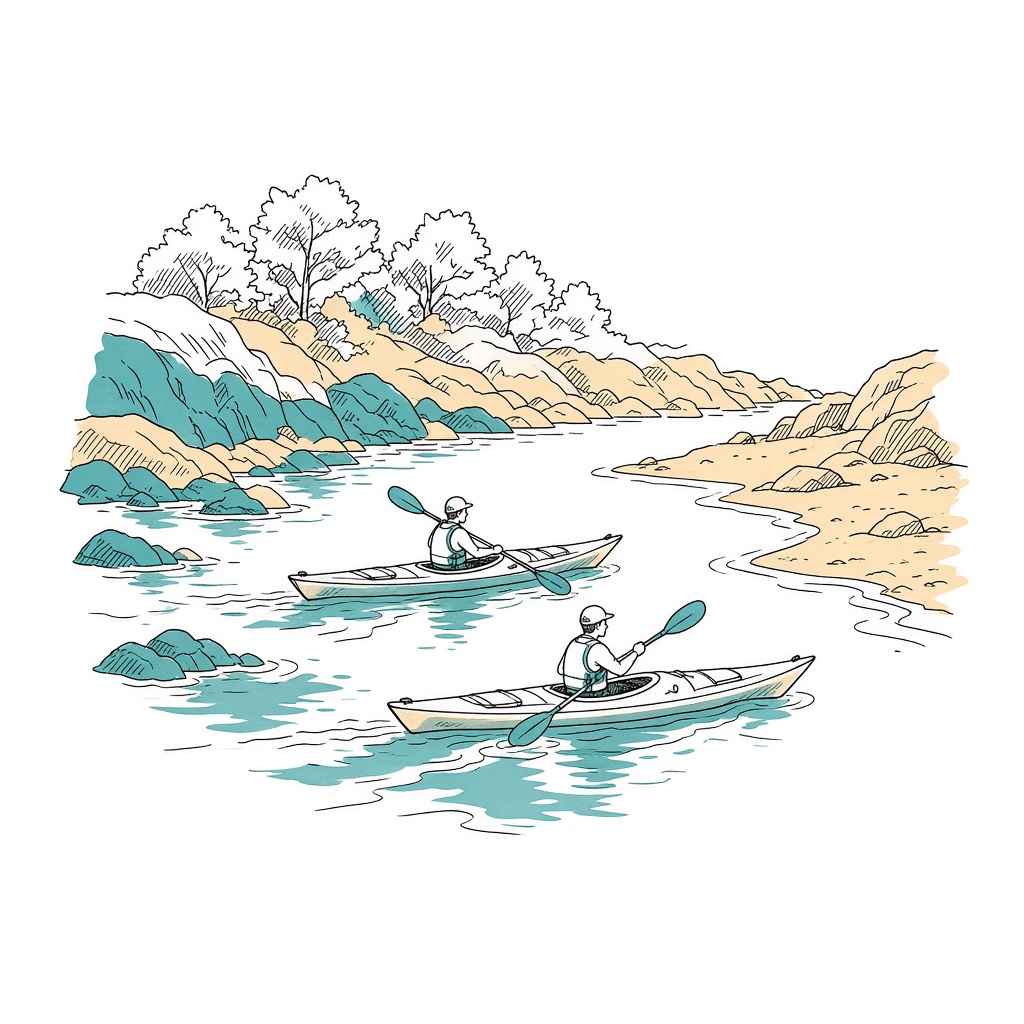
ACA Level 2: Essentials of Kayak Touring. L2 ialah pintu rasmi laluan pesisir: air tenang, mendarat sentiasa ada, dalam kira-kira 0.5 batu nautika dari pantai. Siapkan tugas jelajah. Kedua-dua belah tidak perlu sama cekap; kerja tetap mesti siap.
Venue dan tetingkap
Tetingkap penilaian ACA: angin bawah 10 knot, ombak atau pecahan pantai tidak lebih kira-kira 1 kaki (0.3 m), arus bawah 1 knot.
Setakat mana setiap kemahiran di tahap ini
Kira-kira 200 ela/meter lebih kurang lurus.
Kira-kira 50 ela/meter dengan kawalan munasabah.
Dari kira-kira 2–2.5 knot, berhenti dalam kira-kira dua panjang bot.
Pusing sekurang-kurangnya ~30°; putar 360° tanpa hanyut depan-belakang besar.
Bergerak sisi kira-kira 3 m; tahan haluan dengan stern rudder sekurang-kurangnya dua panjang bot.
Edge dengan tujuan semasa pusing; low brace yang memulihkan.
Terbalik penuh dahulu; gelung tarik plus cara kedua.
Sekurang-kurangnya satu self-rescue dan satu assisted rescue, kemudian kayuh ke pantai.
Apa yang diajar
Kursus kemahiran: kayuhan → manuver → edge/brace → penyelamatan → jelajah pendek. Venue khusus di L2 ialah kemahiran membangun, bukan pintu lulus/gagal.
Versi tempoh ACA
Essentials of Kayak Touring biasanya sehari penuh.
ACA nyatakan minimum satu hari. Ia mengukur standard, bukan pelajaran pemula kedua.
Ada versi sit-on-top. Jangan campur standard SOT dan kokpit dalam satu penilaian.
Teks di bawah ialah garis panduan pengajaran rasmi ACA terkini (Skills Course) untuk tahap ini, sebagai rujukan sahaja. Hak cipta American Canoe Association. Ringkasan di atas ialah penjelasan Kayacool, bukan ganti sumber asal.
Level 2: Essentials of Kayak Touring Skills Course
Course Overview
The Essentials of Kayak Touring course is designed to teach beginner paddlers to safely and enjoyably kayak on lakes, calm protected ocean environments, and other flatwater settings.
Note: This curriculum may be used for both spray skirted kayaks, as well as non-spray skirted kayaks. Skills not applicable to non-spray skirted kayaks are followed by the notation: *.
Bulkheads are not required; however, some form of flotation must be present to keep the kayak from sinking.
Course Prerequisites
- Acknowledgment of personal compliance with the ACA Essential Eligibility Criteria (EEC)
- Agree to comply with the ACA Code of Conduct
- No prior paddling experience or training is required to participate in this course
Course Duration
The course duration should be adjusted to best fit the needs and goals of the participants. Suggested time: Half a day to one day (4-8 hours).
Course Location / Accessible Venues
Calm, protected water with constant access to safe landing and within .5 nautical miles from shore:
- Winds less than 10 knots
- Waves less than 1 foot (0.3 meters)
- Current less than 1 knot
Course Size
5 Participants : 1 Instructor; with an additional qualified assistant, the ratio can be 10 : 2.
For additional details, see SEIC Policy Manual Chapter 7.
Instructor
This course may be offered by Level 2: Essentials of Kayak Touring (or higher) ACA Instructors, Instructor Trainers, or Instructor Trainer Educators.
Succeeding Courses
Level 2: Essentials of Kayak Touring Skills Assessment
Level 2: Essentials of Kayak Touring Trip Leader Training and Assessment
Level 3: Coastal Kayaking Skills Course
Course Outline
The following is a general summary of content for this course. The content and sequence of instruction should be adjusted to best fit the participant’s needs, class location and time allowance.
Introduction, Expectations, and Logistics
Introduction, Expectations, and Logistics:
- Welcome, introductions, paperwork
- Student and Instructor course expectations and limitations
- Course itinerary and site logistics
- Review waiver, assumption of risk, challenge by choice, medical disclosure
- About the ACA
- Life jacket policy (always wear on water)
- Appropriate personal behavior
- No alcohol / substance abuse
- Proper etiquette on and off the water
- Respect private property
- Practice Leave No Trace ethics
Paddling Environment:
- Wind
- Waves
- Weather
- Water
Personal Preparation:
- Personal ability
- Swimming ability
- Water comfort and confidence
- Fitness, conditioning, and warm up
- Safe paddle and boat handling
- Safety and rescue considerations
- Personal equipment (reviewed by Instructor)
- Learning judgment. prudent behavior, being aware of what you do not know, cannot handle, or should not risk
- Group equipment: extra paddle, dry bags, first aid kit and rescue equipment (depending on the environment and nature of the trip this may include cell phones, 2- way radios, vhf radios, paddle floats, rescue slings, etc.).
- Guidebooks, maps/charts, local knowledge
- Assessing relevant existing and approaching environmental conditions including: tides, weather, time of day, water and air temperature, traffic, and accessibility
- Assessing personal and group dynamics (skills, equipment, group makeup, emotional concerns, logistics, and leadership).
- Filed trip plan
Getting Started:
- Warm-up and stretching
- How to pick up and carry a kayak safely
- Car topping: loading and unloading, racks, straps
- Launching and landing
- Boarding, three points of contact, weight kept low, etc.
- Posture, safety, comfort, effectiveness, rocking, balance
- Spray skirts*
- Water comfort and confidence: wet exits – capsize & effectively exit
- Wet exits* in two ways:
- (1) utilizing the spray skirt grab loop
- (2) releasing the skirt off the hip
- Self-rescue
- How to empty a kayak
- Basic terminology
- Types of strokes (covered in this course): power, turning
- Stroke components: catch, propulsion, recovery (CPR), control, correction
Equipment:
- Lifejackets (PFDs): types, fit
- Kayaks: types, materials, parts (including safety features such as flotation)
- Paddles: types, materials, parts, length, blade size, shape and offset, hand position
- Care of equipment
- Personal equipment: water, food, shoes, hat, sunscreen, insect repellent, sun glasses, eyeglass straps, protective clothing for heat or cold, sponge, bailer/pump, whistle (or other approved sounding device), knife, light
- Optional equipment and outfitting for improved control (for example, skeg, rudder, foot pegs, paddling, back band)
Safety:
- Exercising judgment, safety as a mind-set, etc.
- Cold water shock and hypothermia: recognition, prevention, and treatment
- Dehydration and hyperthermia: hydration, clothing
- Hazards: wind, waves, weather, current, rocks, bridges, piers, dams, strainers, traffic
- Paddling as a group
- Signaling
- Interactions and sharing water with non-powered and powered traffic
- Emergency procedures
Rescue:
- Rescue sequence: reach, throw, row, go (RETHROG)
- Rescue priorities: people, boats, gear
- Demonstrate/participate: T-rescue
- Deep-water re-entries, assisted and solo, with sling, including scoop and paddle float rescues*
- Cross kayak PFD grab assisted rescue
- Unresponsive paddler rescue (for example, “Hand of God” and boat flip)
- Boat assisted rescue, assisting a tired swimmer (pushing or pulling to shore)
- Towing or bulldozing a capsized boat
Maneuvers:
- Paddling in a reasonably straight line
- Spins
- Stopping
- Moving abeam (sideways)
Strokes:
- Forward
- Back (stopping)
- Draw (in water and out of water recovery and sculling draw)
- Sweep (forward and reverse)
- Stern rudder
- Low brace
- Low brace turn
Conclusion and Wrap Up
- Group debrief and individual feedback.
- Course limitations
- Importance of first aid and CPR
- Importance of additional instruction, practice, experience
- Importance of appropriate level of safety and rescue training
- Demonstrate advanced maneuvers
- Life sport and paddling options
- Local paddling groups and clubs
- Handouts and reference materials
- ACA membership
- Course evaluation
- Participation cards (optional)
*Skills not required for those participants paddling a kayak without a spray skirt.
© American Canoe Association
Date of last revision: 5/1/2024
This curriculum is managed by the ACA Coastal Kayaking Committee.